
Quick Takeaways
- Fear is usually about what the mistake might mean, not the mistake itself.
- Playing not to lose creates hesitation. Give your attention a job to do.
- High standards help. Tying your worth to perfect performance does not.
- You do not need to feel fearless. You need to commit to the next action.
How Do You Stop Being Afraid of Making Mistakes in Sports?
You stop being afraid of making mistakes by changing what the mistake means and changing what you do when fear shows up.
Most athletes are not actually scared of missing a shot.
They are scared of what happens after the miss.
Coach might pull me.
My teammates will be mad.
My parents will be disappointed.
Everybody will see that I am not as good as they thought.
Maybe I am not good enough.
That is why telling an athlete to "stop worrying" rarely works. The mistake is only the surface. Underneath it sits a heavier question:
Once a mistake becomes connected to identity, approval, playing time, or self-worth, the athlete's internal instruction changes.
| Performance mindset | Protective mindset |
|---|---|
| Go execute the play. | Do not screw this up. |
| Focuses on a target or cue | Focuses on avoiding failure |
| Produces committed action | Produces hesitation and overthinking |
| Accepts the risk of competition | Tries to protect identity, approval, or status |
Mind Grit teaches a different sequence:
Prepare hard. Accept the risk. Trust your work. Compete.
You do not have to become fearless.
You have to stop letting fear call the plays.
Good Athletes Can Become Afraid to Fail
Fear of mistakes is not limited to athletes who lack talent or preparation. It often shows up in the athlete who cares the most.
He trained all offseason.
She wants the starting spot.
He wants his coach to trust him.
She does not want to disappoint her parents.
Those are not weaknesses. Caring belongs in competition.
But the desire to perform well can quietly turn into a need to avoid performing badly. When that happens, athletes start negotiating with the game.
The quarterback sees the throw, checks it one more time, and the window closes.
The basketball player catches the ball in rhythm, thinks about the miss, and passes up the shot.
The hitter becomes so worried about striking out that he stops attacking hittable pitches.
The defender who just gave up a big play starts playing five yards deeper than the technique calls for.
No one told those athletes to stop competing. Fear simply changed their strategy.
They went from performing to protecting.
What Are Athletes Actually Afraid Of?
Sport research helps answer that question.
In interviews with young elite athletes, researchers found that feared consequences of failure included a diminished view of themselves, a lost sense of achievement, and the emotional cost of failure.[1] Other athlete research has connected fear of failure with shame, embarrassment, perceived pressure, psychological stress, and burnout.[2,3]
The athlete may be afraid of:
- Looking foolish in front of teammates or spectators
- Losing a coach's trust or a place in the lineup
- Disappointing a parent
- Damaging future opportunities
- Confirming a private fear that they are not good enough
This is why two athletes can make the same mistake and react differently.
Quarterback A: Bad read. Learn from it. Next series.
Quarterback B: Coach is going to realize I am not good enough.
Same event. Different meaning. Different response.
The Meaning Ladder
| What happens | What fear adds | What the athlete does |
|---|---|---|
| Event: I missed the shot. | Story: I always choke. | Hesitates on the next open look. |
| Event: I threw an interception. | Story: Coach cannot trust me. | Checks the next window too long. |
| Event: I struck out. | Story: I am embarrassing myself. | Stops attacking hittable pitches. |
The event needs a correction. The story creates a threat.
That distinction is where the work begins.
How Fear Hijacks Performance
How the spiral develops
- 1The result matters
- 2The result starts determining worth
- 3Mistakes begin to feel threatening
- 4The goal shifts from execution to avoidance
- 5The athlete hesitates, overthinks, or plays safe
The mistake is not always what shuts an athlete down.
The story attached to it does.
Shame Is Not the Same as Disappointment
This distinction matters.
| Disappointment | Shame |
|---|---|
| That performance was not good enough. | I am not good enough. |
| Evaluates the action | Attacks the person |
| Points toward correction | Produces hiding, withdrawal, or self-protection |
| Leaves room to learn | Makes the mistake feel like proof |
Research in athletes found that concern over mistakes and perceived parental or coach pressure were related to fear of shame and embarrassment and to more negative reactions after failure.[2]
You want an athlete who can say:
I played badly today.
You do not want every bad performance becoming:
There is something wrong with me.
One response can be coached. The other puts identity on trial.
High Standards Are Not the Problem
Mind Grit is not about lowering standards.
Technique matters. Preparation matters. Execution matters. Winning matters.
But there is a difference between pursuing excellence and demanding perfection.
| Pursuing excellence | Fear-based perfectionism |
|---|---|
| I want to perform at a high level, and I am willing to train for it. | I must perform flawlessly or something is wrong with me. |
| Uses mistakes as feedback | Uses mistakes as evidence of inadequacy |
| Encourages challenge and growth | Encourages avoidance and self-protection |
| Holds a high standard | Makes worth conditional on the standard |
The coaching translation is simple:
Areté is the pursuit of excellence. It is not the demand for perfection.
The Mind Grit Principle: Believe
Believe does not mean:
I know I am going to win.
You do not.
It does not mean:
Nothing bad is going to happen.
Something might.
Believe means choosing what you will trust when the outcome is uncertain.
Competition always contains uncertainty. You can prepare well and still lose. You can make the right read and throw an incompletion. You can hit a good shot and get a bad bounce. You can square up a baseball and line it directly at the shortstop.
There is no mental skill that removes uncertainty from sport.
The useful question is:
| When fear says... | Believe answers... |
|---|---|
| If I make a mistake, everyone will know I am not good enough. | One play does not define my ability or identity. |
| I cannot afford to mess up. | I prepared for this. Now I execute. |
| I have to prove myself. | I have a job. |
| What if I fail? | Then I respond. |
That is belief sturdy enough for competition.
Stop Playing Not to Lose
Ask yourself one question:
Listen to the difference.
| Fear gives a warning | Performance needs a target |
|---|---|
| Do not throw another interception. | Confirm the read. Deliver the ball. |
| Do not miss short. | See the front of the rim. Finish. |
| Do not walk him. | Attack the glove. |
| Do not double fault. | See the target. Finish the serve. |
| Do not get beat. | Win leverage. Trust the technique. |
The purpose is not to pretend the unwanted outcome is impossible. The purpose is to give attention a useful job.
Stop giving fear a warning. Give performance a target.
That cue still has to be trained. A meta-analysis of 32 studies found a moderate positive overall effect of self-talk interventions on sport-related performance, with stronger benefits when the strategy was practiced rather than introduced for the first time under pressure.[6]
The Permission-to-Compete Framework
When fear starts controlling your decisions, use four steps.
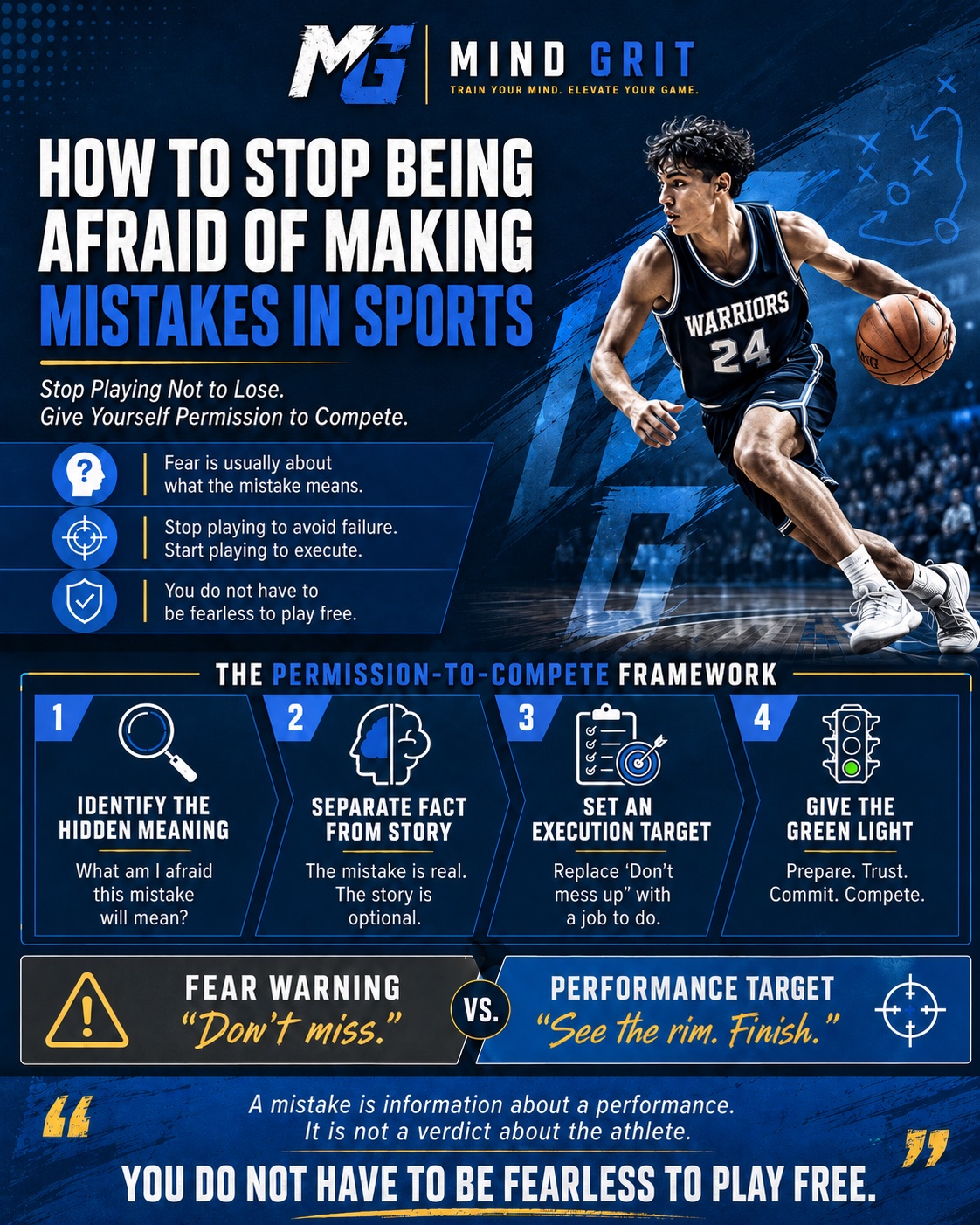
1. Identify the Hidden Meaning
Ask:
Not only what might happen. What are you afraid it will say about you?
Maybe:
- Coach will not trust me
- I will disappoint my parents
- Everyone will think I am overrated
- I will lose my position
- Maybe I am not good enough
Be honest. You cannot challenge a belief you refuse to name.
2. Separate Fact From Story
You threw an interception.
Fact.
Coach will never trust me again.
Story.
You missed the free throw.
Fact.
I always choke.
Story.
You struck out.
Fact.
I am embarrassing myself.
Story.
This is where the Mind Grit One-Play Rule matters: name what happened without turning the event into identity.
Do not let fear write a bigger story than the facts support.
3. Set an Execution Target
Return to the actual job.
Not:
Do not fail.
What are you trying to do?
- Read the safety
- See the ball
- Win leverage
- Attack the glove
- See the rim
- Finish the serve
- Communicate the coverage
- Commit to the shot
This moves the athlete out of self-evaluation and back into sport.
4. Give the Green Light
This is the part athletes often avoid.
You have prepared. You know the job. Now accept that the result is not guaranteed.
Maybe the play works. Maybe it does not.
That is competition.
Give yourself permission to find out.
Prepare. Trust. Commit. Go.
You Do Not Need to Feel Fearless Before You Act
Athletes often judge mental training by whether the fear disappears.
That is the wrong measurement.
Your heart may still be pounding. You may still feel nervous. The thought what if I mess this up? may still be there.
Fine.
You do not need to win a debate with every thought before the ball is snapped.
You can be nervous and still shoot.
You can feel uncertain and still throw.
You can be worried and still compete aggressively.
Fear can be present without being in charge.
The goal is not fearlessness. The goal is committed action.
Practice Making Mistakes
Do not practice bad technique on purpose.
Practice in situations where failure is possible.
A quarterback needs difficult reads. A basketball player needs contested shots. A hitter needs uncomfortable counts. A goalkeeper needs unpredictable situations. A golfer needs pressure games. A tennis player needs meaningful points.
If practice is always designed to protect confidence, the athlete never learns what happens when confidence gets challenged.
Pressure practice teaches:
That belief matters more than trying to convince yourself that mistakes will never happen.
You are building evidence that failure can happen without ending you. For more on evidence-based confidence, read How to Build Confidence in Sports.
Stop Checking Your Confidence During the Game
After one mistake, athletes often start monitoring themselves.
Do I still feel confident?
Another mistake happens.
Now my confidence is gone.
The athlete has quietly accepted a new job: fix my confidence.
That is the wrong job during competition.
Confidence should be built before the game through preparation, repetition, difficult practice, film, physical training, and promises kept to yourself. During the game, your job is execution.
Sometimes confidence leads action. Sometimes committed action gives confidence new evidence. Either way, checking your confidence every thirty seconds takes attention away from the play.
What Five Mental-Performance Books Add to the Conversation
Peer-reviewed research and applied coaching literature are not the same kind of evidence. Research helps us understand fear of failure, shame, perfectionism, self-talk, and athlete well-being. Experienced coaches and performers often give us language and routines that make those ideas usable.
These five books point toward the same practical lesson: the mental game must be trained before pressure arrives.
| Book | Useful lesson for fear of mistakes |
|---|---|
| Mind Gym by Gary Mack with David Casstevens | Mental responses need reps. Do not expect your mind to execute a skill you have never practiced. |
| 10-Minute Toughness by Jason Selk | A short, repeatable routine gives you structure when emotion and doubt get loud. |
| With Winning in Mind by Lanny Bassham | Train a consistent mental process so every single result does not have to carry your identity. |
| The Champion's Comeback by Jim Afremow | Fear gets smaller when you trust your ability to respond to setbacks. The stronger belief is not “nothing bad will happen,” but “I know how to come back.” |
| Changing Your Story by Bill Beswick | One bad play is a chapter, not the whole story. Athletes can question the story they keep repeating and choose a more useful one. |
Different language. Same direction.
Train your response. Use a routine. Trust the process. Know how you will come back. Do not let one chapter become your identity.
Your Identity Cannot Be on Trial Every Play
Fear becomes much bigger when every play is forced to answer one question:
Who am I?
This is especially important for young athletes. They train for years. Their friends may come from the team. Their parents invest time and money. Their future goals may depend on performance. Eventually, I play football can quietly become I am football.
Now every mistake carries too much weight.
Sports should matter deeply. But your entire identity cannot depend on what happened on Friday night.
A bad performance can tell you what needs work. It cannot tell you everything about who you are.
That is why Areté asks a better question:
One performance is information inside that pursuit. It is not the final verdict.
What Parents and Coaches Need to Understand
Fear of failure does not develop in isolation. The environment around the athlete matters.
Research with adolescent athletes has identified parental behaviors such as punitive responses, controlling behavior, and high expectations as possible contributors to fear of failure.[4] Research has also connected controlling coaching styles with greater fear of failure.[5]
That does not mean parents and coaches should stop correcting athletes.
Athletes need standards. They need honest feedback. They sometimes need consequences.
But correction should tell the athlete what to do next, not make the athlete wonder whether one mistake changed the relationship.
| A mastery response | A threatening response |
|---|---|
| Your eyes were in the wrong place. Confirm the safety and let it go. | How could you screw that up again? |
| Evaluates the action | Attacks the athlete |
| Teaches a correction | Creates a threat |
| Returns attention to the next job | Keeps attention on judgment |
| Builds resilience and trust | Encourages hesitation and protection |
For coaches:
Demand high execution. Give a clear correction. Then give the athlete another chance to compete.
For parents:
Protect the relationship. Evaluate the performance. Those conversations do not always need to happen at the same time.
The Three-Practice Permission-to-Compete Challenge
Use one cycle for three practices:
CATCH THE WARNING → NAME THE FEAR → FLIP TO EXECUTION → GRADE THE RESPONSE
For your next three practices, audit your internal language.
1. Catch the Warning
Listen for:
- Do not miss
- Do not throw it there
- Do not get beat
- Do not strike out
- Do not embarrass yourself
2. Name the Fear
Ask:
3. Flip to Execution
Turn every warning into a target.
- Do not miss → See the rim. Finish.
- Do not get beat → Win leverage.
- Do not strike out → See the ball. Attack my pitch.
4. Grade the Right Thing
At the end of practice, do not grade perfection.
Ask:
That is a useful mental-performance measurement.
Train This Week
One Question
What am I afraid a mistake will say about me?
Do not give the tough answer. Give the honest one.
One Action
Complete these two statements:
Fear says: If I __________, it means __________.
Believe says: My job is __________.
Example:
Fear says: If I throw another interception, it means Coach cannot trust me.
Believe says: My job is to confirm the read, trust the work, and deliver the football.
Bring that statement into your next three practices.
One Verse
This verse does not promise that fear will never speak.
It asks a better question:
What will govern me when fear shows up?
One Takeaway
Frequently Asked Questions
Why am I so afraid of making mistakes in sports?
Many athletes are not afraid of the technical mistake alone. They fear the meaning and consequences they attach to it: shame, embarrassment, disappointment, loss of playing time, or the belief that the mistake proves they are not good enough. Ask, What am I afraid this mistake will mean? That question often reveals the real fear.
How do I stop thinking “do not mess up” during games?
Replace the warning with an execution cue. Instead of do not miss, use see the target. Instead of do not throw a pick, use confirm the read. You do not have to suppress every negative thought. Redirect attention toward the next useful action.
Can I play well while I still feel nervous or scared?
Yes. You do not need total calm or certainty to execute. Use your routine, identify the next job, and commit. The goal is not always to remove fear. It is to prevent fear from controlling the decision.
Is perfectionism bad for athletes?
High standards are not inherently harmful. The bigger concern is a destructive reaction to imperfection: harsh self-criticism, shame, avoidance, and the belief that a mistake changes your worth. The goal is a high standard and a healthy response.
What should a coach say to an athlete who is afraid to make mistakes?
Give the athlete an executable job. Correct the technique without attacking identity. For example: Your eyes were in the wrong place. Confirm the safety first. Trust it and let it go. Then provide another opportunity to compete.
What should parents say after a bad game?
Start by being the parent. Your athlete can receive honest feedback without believing your approval depends on performance. A useful principle is: Protect the relationship. Evaluate the performance. The car ride home does not have to become an immediate film session.
How do I recover after I actually make the mistake?
Use the Mind Grit One-Play Rule: make one mistake cost you one play, not the next three. Name what happened, leave the completed play, find the next job, and do it.
Stop Protecting Yourself From the Game
At some point, every serious athlete has to choose.
You can try to protect yourself from every possible mistake.
Or you can compete.
You cannot fully do both.
Competing means there is risk. The shot might miss. The pass might get intercepted. You might strike out. You might lose.
None of those outcomes gets the final word on who you are.
Prepare hard enough to trust your work. Hold yourself to a high standard. Learn from every mistake.
But when the opportunity arrives, stop protecting.
Give yourself permission to compete.
You do not need certainty. You do not need perfection. You do not even need to be fearless.
You need enough courage to take what you trained into the arena and find out what happens.
You do not have to be fearless.Play free.
That is Believe.
Article Summary
- Fear grows when athletes treat mistakes as threats to identity, approval, or opportunity.
- Playing not to lose shifts attention from execution to protection.
- High standards help athletes grow; shame and fear-based perfectionism make mistakes feel dangerous.
- The Permission-to-Compete Framework turns fear into a usable sequence: identify the meaning, separate fact from story, set an execution target, and give the green light.
- Athletes do not need to feel fearless. They need a trained response that returns them to committed action.
Start With the Five Pillars
Fear of mistakes is one part of the mental game. The Mind Grit Five Pillars give athletes a larger framework for pressure:
- Areté: Who am I becoming?
- Believe: What do I choose to believe when pressure comes?
- Control: What is mine to own right now?
- Fall 7. Rise 8.: How will I respond?
- Have Fun: Am I free enough to play the game I love?
Download the Free Mind Grit Five Pillars Guide
Related Mind Grit Articles
- How to Focus Under Pressure in Sports - Give your attention one external job when the moment gets big.
- How to Recover After a Mistake in Sports - Make one mistake cost you one play, not the next three.
- How to Build Confidence in Sports - Build confidence from preparation and evidence before you need it.
About Graves Fromang, DO
Graves Fromang, DO, is a board-certified emergency physician, mental performance coach, football coach, former college football player, father, and founder of Mind Grit.
He was a two-time All-State high school football player and played four years of college football at Sewanee, earning First-Team All-Conference honors at linebacker. He later became an emergency physician and has spent more than a decade making decisions in high-pressure clinical environments while coaching young athletes.
Those experiences helped shape the Mind Grit System: a practical, faith-grounded mental-performance framework that helps athletes pursue excellence, build confidence, focus on what they control, respond to adversity, and compete without allowing performance to determine identity.
Evidence Note
Research References
1. Sagar SS, Lavallee D, Spray CM. Why young elite athletes fear failure: Consequences of failure. Journal of Sports Sciences. 2007;25(11):1171-1184. doi:10.1080/02640410601040093.
2. Sagar SS, Stoeber J. Perfectionism, fear of failure, and affective responses to success and failure: The central role of fear of experiencing shame and embarrassment. Journal of Sport & Exercise Psychology. 2009;31(5):602-627. doi:10.1123/jsep.31.5.602.
3. Gustafsson H, Sagar SS, Stenling A. Fear of failure, psychological stress, and burnout among adolescent athletes competing in high level sport. Scandinavian Journal of Medicine & Science in Sports. 2017;27(12):2091-2102. doi:10.1111/sms.12797.
4. Sagar SS, Lavallee D. The developmental origins of fear of failure in adolescent athletes: Examining parental practices. Psychology of Sport and Exercise. 2010;11(3):177-187. doi:10.1016/j.psychsport.2010.01.004.
5. Moreno-Murcia JA, Hernández EH, Marín LC, Nuñez JL. Coaches' motivational style and athletes' fear of failure. International Journal of Environmental Research and Public Health. 2019;16(9):1563. doi:10.3390/ijerph16091563.
6. Hatzigeorgiadis A, Zourbanos N, Galanis E, Theodorakis Y. Self-talk and sports performance: A meta-analysis. Perspectives on Psychological Science. 2011;6(4):348-356. doi:10.1177/1745691611413136.
Applied Mental-Performance Reading
- Mack G, Casstevens D. Mind Gym: An Athlete's Guide to Inner Excellence. McGraw-Hill.
- Selk J. 10-Minute Toughness: The Mental Training Program for Winning Before the Game Begins. McGraw-Hill.
- Bassham LR. With Winning in Mind: The Mental Management System. Mental Management Systems.
- Afremow J. The Champion's Comeback: How Great Athletes Recover, Reflect, and Re-Ignite. Rodale Books.
- Beswick B. Changing Your Story: How to Take Control of Your Life, Create Change and Achieve Your Goals. Penguin Life.
Medical and Mental Health Disclaimer
Mind Grit provides educational mental-performance content for athletes, parents, and coaches. It is not medical advice and is not a substitute for individualized medical care, diagnosis, psychological treatment, or mental-health counseling. Participation in Mind Grit content or coaching does not create a physician-patient relationship.
Fear, nerves, and worry can be normal parts of competition. Athletes experiencing persistent or severe anxiety, panic, depression, disordered eating, self-harm thoughts, major avoidance, or distress affecting life outside sport should seek evaluation from an appropriately licensed healthcare or mental-health professional.