
Quick Takeaways
- Pressure redirects focus. It pulls attention toward threat, outcome, and worry.
- Do not coach your mechanics mid-play. Let automatic skills stay automatic.
- Point attention outward. A clear external target supports execution.
- Give attention one job. You control where your focus goes next.
How Do You Focus Under Pressure in Sports?
You focus under pressure by giving your attention one external job before the play.
That means keeping your mind off the outcome, your mechanics, and what might go wrong.
You are at the free-throw line late in the game. You have made this shot hundreds of times. Then you notice your elbow, the crowd, the score, and what happens if you miss.
The skill did not disappear. Your attention moved.
Athletes are often told to lock in, get their head right, or stop thinking. None of that gives attention somewhere useful to go. "Don't think about missing" still puts the miss on the screen.
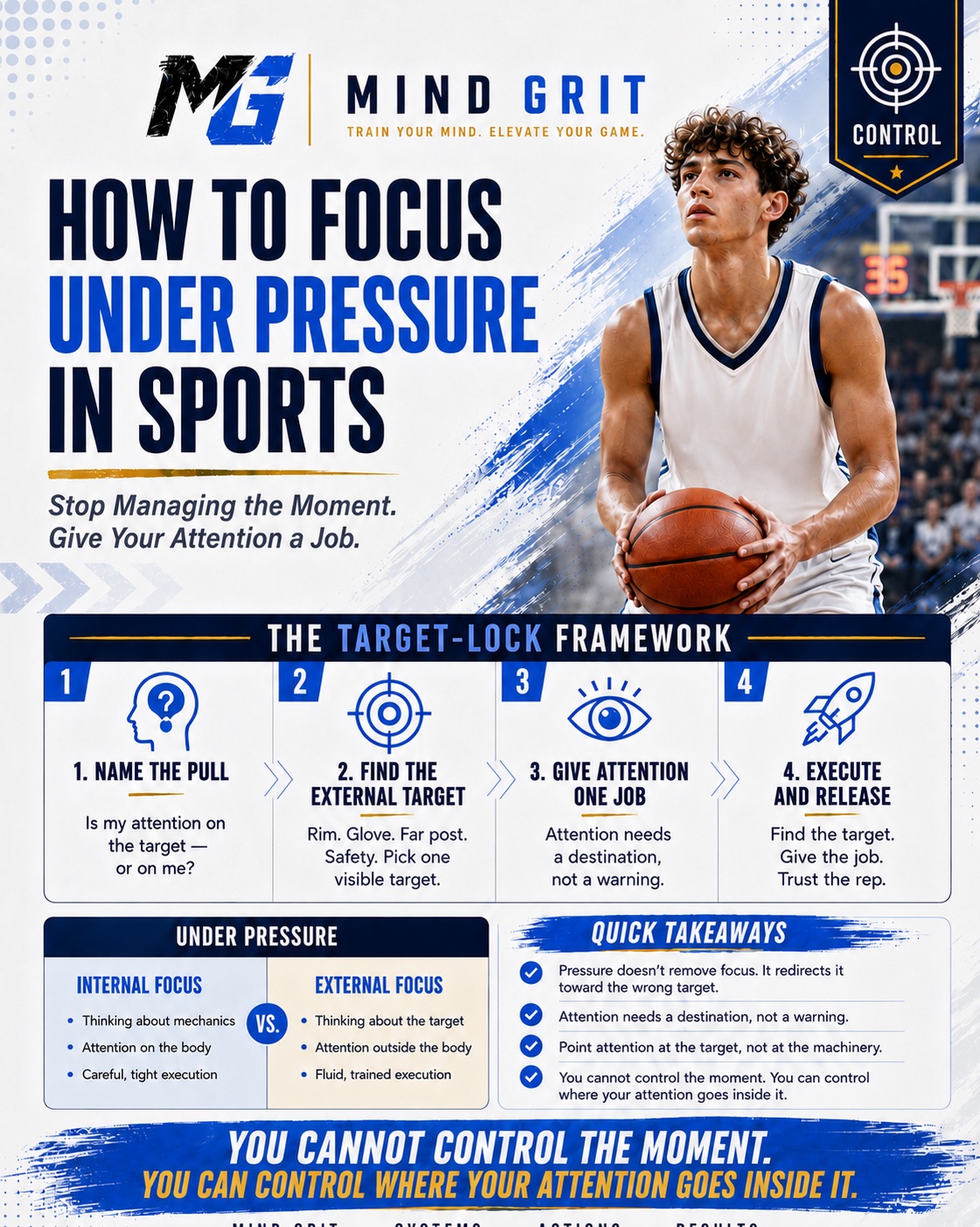
The Mind Grit Target-Lock Framework gives it one:
You do not need the moment to feel small. You need your attention pointed somewhere useful inside it.
Why Pressure Breaks Focus
Pressure changes what athletes notice. Attention moves from the job in front of them toward threat, outcome, and self-protection.
Pressure does not switch focus off. It hijacks it and points it at the crowd, the scoreboard, or the last mistake instead of the play in front of you.
In practice, this looks like:
- A hitter notices the crowd, the scoreboard, and the last at-bat all at once
- A goalkeeper replays the goal instead of watching the next attack
- A free-throw shooter jumps to the score, the clock, and what happens after a miss
Attention did not disappear. It got hijacked.
The Real Problem: Thinking About Your Own Body
Pressure can also pull attention onto the athlete's own body.
Researchers call this explicit monitoring. Under pressure, athletes become more self-conscious and start consciously controlling movements that used to run automatically.3 A skill that took years to make automatic gets broken back down into individual steps, and every step becomes a new place to fail.
You started thinking about a movement your body already knows how to do. That is the problem.
This is why a golfer can suddenly steer a three-footer or a good free-throw shooter can push a shot in a tied game. The skill did not disappear. Attention moved to the wrong place.
| Trained execution | Pressure-driven monitoring |
|---|---|
| Trust the motion | Think through the motion step by step |
| Skill runs automatically | Skill gets broken into parts |
| Attention stays on the target | Attention turns toward the body |
| Fluid execution | Careful, mechanical execution |
Do not turn an automatic skill back into a checklist when the game is moving.
Two Kinds of Focus
Internal focus points attention at your own body: your elbow, your feet, your grip, your follow-through.
External focus points attention at something outside your body: the rim, the target, the glove, the seam of the ball.
Internal cues still have a place when an athlete is learning or correcting mechanics in practice. During competition, especially after the skill has become automatic, attention usually needs to move toward the target and task.
| Internal focus | External focus |
|---|---|
| Keep your elbow up | Shoot over the front of the rim |
| Follow through with your wrist | Drive the ball through the glove |
| Keep your head down | Watch the ball onto the bat |
| Plant your foot | Attack the far post |
| Snap your wrist | Roll the ball over the top of the net |
The Mind Grit Principle: Control
Control does not mean controlling the outcome or preventing mistakes.
It means owning what is actually yours in the moment: where you look, what job you give your mind, and how you respond.
You cannot control the referee, the bounce, the defense, or whether the shot goes in. You can control where your eyes go and what your attention does before you act.
| When pressure says... | Control answers... |
|---|---|
| Do not miss this | See the target |
| Everyone is watching | My job is here, not in the stands |
| What if my mechanics break? | Trust the rep. Watch the target |
| I need to calm down | I need a job for my attention |
That is focus you can take into competition.
Why "Calm Down" Doesn't Work
Telling a nervous athlete to relax rarely helps, because it gives the mind nothing to do.
Athletes under pressure do not always need less activation. They need that energy redirected. Interviews with elite athletes found that stronger anxiety was often paired with more effort to maintain performance, not an automatic collapse.6
Nerves are not the enemy. An unassigned mind is. Stop trying to feel calm. Start giving attention a target.
The Target-Lock Framework
When pressure starts pulling your attention inward, use four steps.
- 1
Name the Pull
Ask: Is my attention on the target, or on me?
- 2
Find the Target
Choose one visible thing outside your body.
- 3
Give One Job
Use one short, trained cue tied to execution.
- 4
Execute and Release
Trust the motion. Stop grading it mid-play.
Name the Pull
Ask: Where is my attention right now—on the target, or on me?
Notice whether you are thinking about your grip, your feet, your form, the score, or what happens if you fail.
Find the External Target
Every skill has one visible thing to lock onto.
- The rim, not your elbow
- The catcher's glove, not your arm slot
- The far post, not your plant foot
- The seam of the ball, not your grip
- The safety's leverage, not your footwork
- The service box, not your toss hand
Name the target before you compete, not during it.
Give Attention One Job
Not: Do not miss.
One phrase. One target. One job.
- See the rim. Shoot.
- Watch the glove. Throw.
- Find the gap. Go.
A meta-analysis of self-talk research found a meaningful performance benefit from short cue words, with stronger effects when athletes rehearsed the cue in advance.7
A cue only works in the game if you have used it in practice. Do not invent your phrase in the huddle.
Execute and Release
Once the job is given, let the body do what it was trained to do.
Do not audit mechanics mid-motion. Do not grade the process while it is happening.
Training Focus Before You Need It
Focus under pressure is not a personality trait. It is a trained skill.
Experienced performance coaches use different language, but the lesson is consistent: keep attention on the job, trust trained movement, and rehearse the response before pressure arrives.
The athletes who trained focus under practice pressure held onto it under real pressure. The athletes who trained mechanics alone did not get the same protection.
If you only practice focus when things are easy, you have not trained the skill you need.
Ways to train it:
- Add a scoreboard, countdown, or consequence to practice reps
- Say your target cue out loud before pressure reps
- Rehearse Target-Lock when missing has a cost
- Review film for where your eyes and attention went, not only the outcome
If a mistake starts an internal play-by-play—Was my form off? Did I panic?—use the Mind Grit One-Play Rule and return attention to the next job.
Why This Matters for Young Athletes
Young athletes are still building the automatic skills that experienced athletes take for granted. That makes them vulnerable to a common trap: coaching cues that point attention at the body instead of the target.
Keep your elbow up. Get your foot down. Follow through.
Those cues are not wrong during teaching reps. But repeating them immediately before the play can pull attention inside the athlete's body when it needs to be outside.
| Teaching cue in practice | Competition cue in the game |
|---|---|
| Keep your elbow up on the follow-through | See the back of the rim |
| Step toward your target | Find the glove |
| Keep your head down through contact | Watch the ball onto the bat |
Teach the mechanics in practice. Hand the athlete a target in competition.
What Parents and Coaches Need to Understand
Athletes cannot control the scoreboard, the referee, the weather, or the bounce. When adults talk as if the outcome is the thing to manage, athletes point attention at the wrong place too.
| Control-based response | Outcome-based response |
|---|---|
| What's your job on this play? | We need this one. Do not blow it |
| Points attention at the task | Points attention at the result |
| Builds a trainable habit | Builds outcome anxiety |
| Returns the athlete to execution | Keeps the athlete monitoring the score |
For coaches: Give athletes a target, not a warning. Ask about the job, not the outcome.
For parents: Before the game, ask what they are focusing on. After the game, ask about the effort and response, not only the result.
The Three-Practice Target-Lock Challenge
Use this cycle for three practices
- Notice the drift
- Name the target
- Give one job
- Grade the focus
During pressure reps, notice when attention drifts inward. Say the external target out loud, turn it into a short competition cue, and then grade where your attention went—not only whether the play worked.
Train This Week
One Question
When pressure shows up, does my attention go to the target, or to myself?
One Action
Complete these statements for your sport:
My external target is: __________.
My one-word job is: __________.
Use that target and cue in your next three pressure reps.
One Verse
"Let thine eyes look right on, and let thine eyelids look straight before thee."
Proverbs 4:25, KJV
Control begins with deciding where your attention belongs. This verse gives athletes a simple picture of that discipline: eyes forward, attention fixed, next job.
One Takeaway
Frequently Asked Questions
Why do I lose focus during big games even though I don't in practice?
Pressure pulls attention toward threat, outcome, and self-monitoring instead of the task in front of you. You are not mentally weak. Your attention has been pulled off the job, and that response can be trained.
Should I focus on my technique or the target when I'm nervous?
For many motor skills, research favors an external focus on the target over consciously monitoring body mechanics, especially under pressure. Save detailed technical cues for practice.
What should I say to myself right before a big moment?
Use a short, specific external cue you have already practiced. "See the rim" works. "Don't miss" does not, because it still points attention at the miss.
How do I train focus if it only breaks down in real games?
Add manageable consequences to practice: a countdown, scoreboard, competition, or cost for missing. Rehearse the same target and cue you will use in games.
Stop Managing the Moment
You do not control the scoreboard, the crowd, the referee, or the bounce. You control where your attention goes right before you act.
Pressure will pull it toward your body, the outcome, or the fear of failing. Point it back toward the target in front of you.
Find the target. Give the job. Trust the rep.
That is Control.
Pressure is coming.Train for it.
Related Mind Grit Articles
- How to Stop Being Afraid of Making Mistakes in Sports — Give yourself permission to compete instead of playing not to lose.
- How to Build Confidence in Sports — Build confidence from preparation and evidence before you need it.
- How to Recover After a Mistake in Sports — Make one mistake cost you one play, not the next three.
About Graves Fromang, DO
Graves Fromang, DO, is a board-certified emergency physician, mental performance coach, football coach, former college football player, father, and founder of Mind Grit.
He created the Mind Grit System to give athletes a practical, faith-grounded framework for pursuing excellence, building confidence, controlling attention, responding to adversity, and competing without allowing performance to determine identity.
Evidence Note
The Target-Lock Framework is a Mind Grit applied coaching concept. It is not an independently validated psychological treatment or sport-psychology protocol.
Mind Grit draws from peer-reviewed research on attentional control, motor learning, explicit monitoring, and choking under pressure and translates those findings into coaching language. The applied practitioners below are included as influential perspectives and should not be treated as equivalent to peer-reviewed evidence.
Research References
1. Eysenck MW, Derakshan N, Santos R, Calvo MG. Anxiety and cognitive performance: attentional control theory. Emotion. 2007;7(2):336-353. doi:10.1037/1528-3542.7.2.336.
2. Brimmell J. The role of attentional control in sport performance [dissertation]. York St John University; 2022.
3. Beilock SL, Carr TH. On the fragility of skilled performance: What governs choking under pressure? Journal of Experimental Psychology: General. 2001;130(4):701-725. doi:10.1037/0096-3445.130.4.701.
4. Chua LK, Jimenez-Diaz J, Lewthwaite R, Kim T, Wulf G. Superiority of external attentional focus for motor performance and learning: Systematic reviews and meta-analyses. Psychological Bulletin. 2021;147(6):618-645. doi:10.1037/bul0000335.
5. McNevin NH, Shea CH, Wulf G. Increasing the distance of an external focus of attention enhances learning. Psychological Research. 2003;67(1):22-29. doi:10.1007/s00426-002-0093-6.
6. Edwards T, Kingston K, Hardy L, Gould D. A qualitative analysis of catastrophic performances and the associated thoughts, feelings, and emotions. The Sport Psychologist. 2002;16(1):1-19.
7. Hatzigeorgiadis A, Zourbanos N, Galanis E, Theodorakis Y. Self-talk and sports performance: A meta-analysis. Perspectives on Psychological Science. 2011;6(4):348-356. doi:10.1177/1745691611413136.
8. Vine SJ, Wilson MR. Quiet eye training: Effects on learning and performance under pressure. Journal of Applied Sport Psychology. 2011;23(4):361-376. doi:10.1080/10413200.2011.573773.
9. Nibbeling N, et al. When the going gets tough, what happens to quiet eye? The role of time pressure and performance pressure during basketball free throws. Psychology of Sport and Exercise. 2021.
Applied Coaching and Sport Psychology Reading
These coaches and performance practitioners use different systems, but each reinforces a useful part of the same applied lesson: direct attention toward execution, trust trained movement, and move forward.
Afremow, J. (2016). The champion's comeback: How great athletes recover, reflect, and re-ignite. Rodale Books.
Bassham, L. R. (2012). With winning in mind: The mental management system (3rd ed.). Mental Management Systems.
Beswick, B. (2021). Changing your story: How to take control of your life, create change and achieve your goals. Penguin Life.
Mack, G., & Casstevens, D. (2001). Mind gym: An athlete's guide to inner excellence. McGraw-Hill.
Selk, J. (2008). 10-minute toughness: The mental training program for winning before the game begins. McGraw-Hill.
Medical and Mental Health Disclaimer
Mind Grit provides educational mental-performance content for athletes, parents, and coaches. It is not medical advice and is not a substitute for individualized medical care, diagnosis, psychological treatment, or mental-health counseling. Participation in Mind Grit content or coaching does not create a physician-patient relationship.
Nerves, distraction, and pressure are normal parts of competition. Athletes experiencing persistent or severe anxiety, panic, depression, disordered eating, self-harm thoughts, major avoidance, or distress affecting life outside sport should seek evaluation from an appropriately licensed healthcare or mental-health professional.