
Quick Takeaways
- Confidence is earned, not summoned. Athletes build it through preparation, successful repetitions, honest feedback, and learning how to respond when things do not go perfectly.
- Confidence should be specific. Instead of asking, “Am I confident?” ask, “What do I trust myself to do in this situation?”
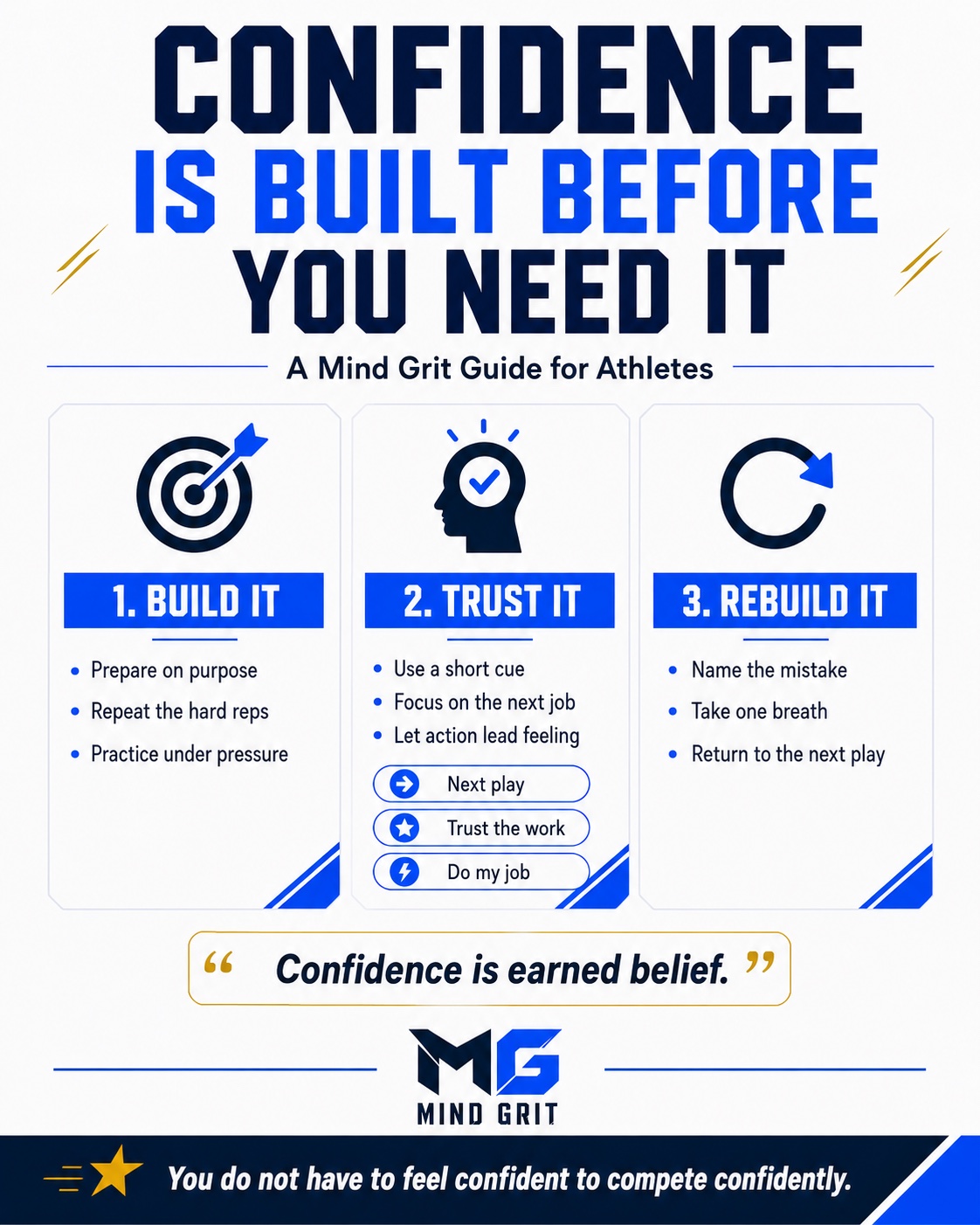
- You do not have to feel confident to compete confidently. When doubt shows up, return to your preparation, your cue, and the next controllable action.
Confidence is easy to recognize when everything is going well.
The quarterback is seeing the field. The shooter is letting it fly. The hitter looks comfortable in the box. The golfer is committed over the ball. A few good plays turn into a good quarter, a good game, maybe a great stretch of the season.
From the outside, we say:
“She’s playing with confidence.”
But that is not when confidence matters most.
Confidence matters after the interception; after two strikeouts; after you miss the shot you normally make; after the opponent scores first; after the coach gets on you.
Then it happens - your mind starts asking questions that cannot be answered in the middle of a game: What if I mess up again? What if I’m not ready? What if I let everybody down?
This is where confidence becomes a performance skill. This is why athletes need to understand one of the central principles we teach at Mind Grit:
You do not manufacture durable confidence in the locker room five minutes before competition. You cannot depend on your parents, your coach, a music playlist, or a motivational speech to hand it to you.
You build confidence through preparation, through repetition, through doing hard things, through keeping promises to yourself, through seeing yourself improve, through making mistakes, responding, learning, and going again.
Then pressure arrives and you have something to trust - something that you believe in.
That is real athlete confidence. Not certainty. Not arrogance. Not hype.
How Do Athletes Build Confidence in Sports?
Athletes build confidence by accumulating evidence that they can trust themselves to perform a specific task and respond effectively when things do not go perfectly.
That last part matters.
Confidence is not convincing yourself:
I am definitely going to win.
You cannot know that.
You cannot guarantee the scoreboard, the official, the opponent, the weather, the depth chart, or whether the ball takes a bad bounce.
But you can know: I prepared for this. I know my job. I have done difficult things before. I have been uncomfortable before. I know what to do next.
That kind of confidence is much harder for one bad play to destroy.
But confidence does not replace skill.
It does not replace preparation.
And it certainly does not guarantee an outcome.
Confidence matters because it changes how willing you are to use what you have trained when the moment becomes uncomfortable.
The Problem With “Just Be Confident”
I have coached long enough to hear versions of this conversation over and over again.
An athlete makes a mistake. The shoulders drop. The eyes change.
Dad says:
“Come on. Be confident.”
Coach says:
“You’ve got to believe in yourself.”
And the athlete is probably thinking:
Great. How?
That is the missing piece.
We tell athletes to be confident as though confidence were a switch they forgot to turn on.
It isn't.
And telling a struggling athlete to “just be confident” can actually give him one more thing to worry about.
Now he is nervous and wondering why he cannot make himself feel confident.
So one of the first things I want athletes to understand is this:
Your feelings do not have to be perfect before your behavior can be excellent.
You can feel nervous and make the read.
You can have doubt and attack the pitch.
You can feel uncomfortable and take the open shot.
You can feel pressure and execute your assignment.
Sometimes confidence comes first and action follows.
But sometimes action comes first and confidence follows.
That is an important distinction because otherwise athletes spend half the competition checking their internal emotional dashboard:
Do I feel confident yet?
Are the nerves gone yet?
Do I feel ready now?
Stop checking.
See what the moment requires.
Do your job.
Confidence Is More Specific Than Most Athletes Think
One of the most important ideas in the science of confidence comes from psychologist Albert Bandura's foundational work on self-efficacy (Bandura 1997).
Self-efficacy is not simply thinking that you are a good person.
It is not even the broad belief that you are “a good athlete.”
It refers more specifically to your belief in your ability to organize and execute what a particular situation requires. Bandura's work became foundational to how psychologists understand confidence, motivation, persistence, and behavior.
That distinction changes the coaching conversation.
An athlete tells me:
“I don't have any confidence.”
Usually that isn't completely true. He may trust his tackling but not his coverage.
She may trust her forehand but not her second serve.
He may trust his fastball but lose confidence pitching with runners on base.
She may shoot freely during practice but tighten up against an aggressive closeout.
A quarterback may know the offense cold against the base defense but become hesitant when the picture changes after the snap.
Now we have something useful.
Instead of asking:
“How do we make you more confident?”
ask:
“What specific situation don't you trust yourself in yet?”
That is a much better question.
Because now we can train something.
Where Does Sports Confidence Come From?
Sport psychologist Robin Vealey's work helped establish sport-confidence as something more nuanced than a vague personality trait. Her research examined the different sources athletes use when judging whether they are ready and capable of performing (Vealey 1998).
That fits remarkably well with Bandura's broader work on self-efficacy.
- Athletes develop confidence from several places:
- What they have successfully done before
- What they repeatedly demonstrate in training
- Physical and mental preparation
- Feedback from coaches and teammates
- Observing others perform successfully
- How they interpret nerves, fatigue, and physical sensations
- How they respond when the experience does not go perfectly
But there is one source that deserves special attention:
Doing the Thing
You did it.
It's not someone who told you that you could do it; it's not someone who posted a quote about believing in yourself; and it's not your mom telling you that you're amazing on the ride to the game.
You did the work and saw yourself do it.
That is what matters the most. Real examples of YOU performing at your best and accomplishing that goal or task.
A linebacker who has correctly fitted the same run concept dozens of times has evidence.
A pitcher who has trained velocity has evidence.
A basketball player who has made hundreds of game-speed corner threes has evidence.
A soccer player who has repeatedly practiced finishing while tired has evidence.
A quarterback who has seen that coverage over and over again and consistently made the correct decision has evidence.
This is one reason preparation and confidence should never be separated.
You are not only training the skill.
You are giving your future self something to believe in, something to feel confident about.
Confidence Needs Receipts
This is how I explain it to athletes:
If you are going to ask your brain to trust you when the game gets difficult, give it receipts.
What proves that you are ready?
Not your recruiting ranking.
Not your Instagram followers.
Not what Dad says.
Not what the crowd thinks.
Not even what your coach tells you.
What have you actually done that gives you a reason to trust yourself?
Performance psychologist Nate Zinsser makes a related argument in The Confident Mind: performers have to become intentional about what they retain from training and competition rather than allowing mistakes and failures to dominate their internal record (Zinsser 2022).
And athletes can be terrible historians.
An athlete can practice for ninety minutes, do 47 things correctly, make three mistakes, and ride home thinking only about the three mistakes.
Ask:
“What went wrong today?”
Instant answer.
Ask:
“What did you do well?”
Silence.
That's a problem.
Because your mind cannot use evidence you refuse to keep.
So start collecting receipts.
- After practice, ask:
- What did I do well today?
- What did I improve?
- What difficult situation did I handle?
- Where did I respond better than I used to?
- What does today's work prove?
That is not ego. That is accurate record keeping.
Five Ways Athletes Can Build Real Confidence
1. Prepare for the Situation You Are Afraid Of
This may be the most important one.
When athletes lose confidence in a specific situation, they often try to think their way out of something that needs to be trained.
Afraid of pressure defense? Train pressure defense.
Worried about making free throws late? Shoot them tired, with a score, routine, and consequence.
Struggling against the inside fastball? Train the inside fastball.
Quarterback unsure against Cover 0? Have the defense line up in Cover 0 on the field.
Goalkeeper worried about penalty kicks? Have the whole team shoot penalty kicks against you.
There is a tendency in mental performance to separate the “mental” side from the physical side too much.
They work together.
Your mind is constantly gathering information from experience.
So make the difficult situation more familiar.
Then when competition arrives, something inside the athlete recognizes it:
I've been here before.
That is confidence with a foundation underneath it.
2. Get Specific About What You Need to Trust
Stop asking:
“Am I confident?”
Ask:
“Confident to do what?”
- Maybe it is:
- make the correct read;
- attack the strike zone;
- take the open shot;
- communicate the coverage;
- finish through contact;
- trust the first step;
- execute the second serve;
- stick to the pre-shot routine.
The more specific the task, the more useful the preparation becomes.
3. Practice Pressure Before Pressure Arrives
You cannot perfectly recreate Friday night on Tuesday afternoon.
You cannot manufacture the exact atmosphere of a state championship during practice.
But you can train pieces of it: Score. Time. Competition. Fatigue. Noise. Consequence. Decision-making. Evaluation.
Put the athlete in situations where the heart rate rises a little and the outcome matters a little.
And then coach the response.
That is important.
The goal is not to make practice miserable. The goal is to teach the athlete:
This feeling does not mean something is wrong.
Pressure may bring a faster heartbeat. Butterflies. Sweaty palms. More energy. Muscle tension. A narrower field of attention.
None of those automatically mean:
I'm not ready.
Sometimes they mean:
This matters to me.
The athlete who understands that stops wasting energy fighting the feeling. He learns to compete while it is there.
4. Train the Voice You Want to Hear Under Pressure
Athletes talk to themselves constantly.
Sometimes out loud.
Mostly internally.
The question is not whether self-talk happens.
The question is whether it sends attention somewhere useful.
The coaching point:
The best self-talk is usually not “I’m awesome.” It is language that directs attention toward the next useful action. See the ball. Trust your feet. Drive through it. Next pitch. Eyes up. Finish. Do my job.
Those words direct attention toward behavior.
And under pressure, attention is precious.
A good cue should not require another cue to explain it.
The athlete does not need a motivational speech between plays.
He needs a target.
5. Learn That Mistakes Don't Cancel Confidence
This is where many young athletes get confidence wrong. They think confident athletes do not make mistakes.
No.
Confident athletes develop a different relationship with mistakes. The mistake becomes information instead of identity.
There is a huge difference between:
“I was late on that ball.”
and:
“I can't hit.”
One is information.
The other is a verdict.
The same thing happens in every sport.
“My feet were bad on that rep.” becomes:
“I suck today.”
“I missed the read.”
becomes:
“Coach can't trust me.”
“I missed two shots.”
becomes:
“I've lost my shot.”
That is where one bad play becomes two.
Then three.
Because now the athlete isn't simply playing the game.
He is playing the game while arguing with a story about himself.
Mind Grit teaches something different:
Name what happened.
Learn what needs to be learned.
Confidence is not believing that you will never fall.
It is knowing that falling does not remove your ability to respond. Growth and confidence are forged in the rise.
That is where Believe connects directly to Fall 7. Rise 8. See my article on How to Recover After a Mistake in Sports.
Visualization Can Help—But It Isn't Magic
Mental rehearsal can be valuable. But visualization has become one of those concepts that sometimes gets separated from reality.
Sitting on the couch picturing yourself holding a trophy does not substitute for preparation.
Useful imagery is specific. You must visualize the environment, the pitch, the play, the read, your breathing, your reactions.
And don't rehearse only perfection.
Picture the first shot missing. Then see yourself sprint back on defense.
Picture giving up the hit. Then see yourself receiving the next sign and throwing the next pitch.
Picture the nerves arriving. Then see yourself noticing them, exhaling, finding your cue, and competing anyway.
That is useful mental rehearsal because you are not just rehearsing success.
You are rehearsing the response.
Visualization should support preparation.
It should never replace it.
Eventually You Have to Let It Go
One of the themes Bob Rotella has reinforced throughout decades of work with golfers and other performers is the importance of commitment (Rotella 2015).
At some point, you have to hit the shot.
You can prepare. You can study. You can analyze. You can build the swing. You can develop the game plan.
But eventually competition arrives and another internal debate will not help you.
Pick the target. Trust the routine. Commit.
That principle extends far beyond golf.
There is a moment in every sport where preparation must become trust.
This is the transition I want athletes to learn:
What to Do When Confidence Drops During a Game
Here is something athletes need to know:
Your confidence may move around during competition.
You might feel great during warmups and terrible ten minutes later.
You might feel unstoppable in the first quarter and uncertain in the third.
That does not mean your preparation disappeared.
And it doesn't mean you have to rebuild your entire psychology between plays.
When confidence drops:
1. State what actually happened.
Not:
I'm terrible.
Instead:
I rushed my feet.
Or:
I was late.
Or:
I made the wrong read.
Specific.
True.
Useful.
2. Take one deliberate breath.
Give yourself a physical marker between the last play and this one.
The last play happened.
This one hasn't.
3. Find the next job.
WIN: What's Important Now?
Coverage.
Pitch.
Possession.
Assignment.
Target.
4. Use one cue and act.
Not six.
One.
This is the key.
Do not wait until you feel completely confident again.
Take the next committed action.
Sometimes behavior has to lead emotion.
Confidence After a Bad Game
Bad games happen.
Sometimes you did not play well.
Sometimes the film is going to hurt.
You do not build real confidence by pretending the performance was great.
But you also do not build it by turning one performance into a judgment about who you are.
Separate the review into three questions:
What happened?
Describe the performance without exaggerating it.
What can I learn?
Identify the correction.
What am I going to train?
Turn the correction into the next practice plan.
That is how judgment becomes instruction.
You are allowed to be disappointed.
You are also responsible for what happens next.
What Parents and Coaches Often Get Wrong About Confidence
When an athlete loses confidence, adults usually want to fix it.
Fast.
So we start supplying reassurance:
“You're amazing.” “You're the best player out there.” “Don't worry about it.” “You're going to dominate tomorrow.”
The intention is good.
But there is a problem.
If every confidence crisis requires Mom, Dad, or Coach to come in and rebuild the athlete, confidence remains dependent on someone else.
Encouragement matters. Relationships matter. Good coaching matters.
But whenever possible, help the athlete find his or her own evidence.
Ask:
“What did your preparation prove?”
“What part of this situation can you control?”
“What specifically went wrong?”
“What needs to be trained?”
“What did you handle better than you would have six months ago?”
“What's your next job?”
That develops ownership.
And ownership travels with an athlete when Mom, Dad, and Coach are not standing beside him.
The Mind Grit Principle: Believe
Believe is one of the Five Pillars of Mind Grit.
But belief does not mean blind optimism.
It does not mean pretending everything is going to work out exactly the way you want.
And it does not mean guaranteeing an outcome that you cannot control.
Mind Grit belief means:
That is why Believe sits beside another Mind Grit pillar:
Control
You do not control whether every shot goes in. You control taking the right shot.
You don't control the official. You control your response.
You don't control the depth chart. You control today's work.
You don't control the opponent. You control your preparation.
You don't control whether pressure shows up. You control what you do when it does.
Confidence becomes less fragile when it rests on things that belong to you.
For the Christian Athlete, Confidence Goes Deeper
There is another reason I don't want athletes building their entire sense of confidence on statistics, rankings, playing time, trophies, recruiting attention, or what a coach thinks of them.
All of those things can change.
And if performance becomes the evidence of your worth, sports can eventually become a brutal place to live.
For the Christian athlete, identity comes before achievement. You are a child of God. You are worthy and you are loved.
That does not reduce ambition. You still prepare relentlessly. You still compete to win.
You still pursue excellence. Areté matters.
But the scoreboard does not get to decide what you are worth.
That gives an athlete freedom.
You can compete from identity instead of constantly competing for identity.
Scripture gives us a place to stand when fear inevitably appears:
“For God gave us a spirit not of fear but of power and love and self-control.” — 2 Timothy 1:7
Faith does not mean nervousness will never show up. It means nervousness does not get to tell you who you are.
Train This Week
Don't spend the next seven days trying to feel more confident.
Build evidence.
One Question
What specific situation in my sport do I trust myself in the least right now?
One Action
Create one practice situation this week that trains that exact moment.
One Habit
- After practice, record three confidence receipts:
- Something you executed well.
- Something difficult you handled.
- Something you improved.
Do it consistently.
And keep it honest.
The receipts have to be real. Fill up that jar.
One Game-Day Cue
Then practice using the cue before you need it.
Coach's Challenge
This week, stop telling an athlete simply:
“Be more confident.”
Instead ask:
“What would give you more evidence?”
That question changes the conversation.
Maybe the athlete needs more reps. Maybe the situation needs to be recreated. Maybe she needs clearer feedback. Maybe he needs to see film proving that he actually made the correct read. Maybe the athlete needs to recognize progress that he keeps overlooking. Maybe there really is a skill deficit that needs to be trained.
Good.
Now we know what to do.
Confidence becomes coachable when we stop treating it like magic.
Frequently Asked Questions About Confidence in Sports
How do you build confidence in sports?
Athletes build confidence by developing specific skills, preparing deliberately, experiencing successful repetitions, receiving useful feedback, training under manageable pressure, and learning to respond effectively after mistakes. Confidence becomes more durable when athletes have real evidence they can point to rather than relying only on encouragement or positive thinking.
How can an athlete build confidence quickly?
You can change your competitive approach quickly, but durable confidence is usually built through repeated evidence. Start with one specific situation, prepare it deliberately, create successful repetitions, add manageable pressure, and develop a simple cue for competition.
Why do athletes lose confidence after one mistake?
A mistake often becomes more damaging when the athlete turns an event into a prediction or an identity statement. “I missed that shot” becomes “I can't shoot today.” The goal is to describe the mistake accurately, make any necessary correction, and redirect attention toward the next controllable action.
Can you play well without feeling confident?
Yes. Athletes do not need a perfect emotional state before taking effective action. You can be nervous, uncertain, or disappointed and still execute the next assignment. Sometimes confident feelings follow committed behavior rather than preceding it.
Does positive self-talk improve athletic performance?
Research supports deliberate self-talk as a potentially useful performance strategy, particularly when athletes actually practice it. The most useful cues tend to be short, believable, and connected to a specific action rather than vague statements such as “I'm the best.”
Does visualization help athletes build confidence?
Mental imagery can help athletes rehearse skills, environments, and responses to pressure when it is combined with physical preparation. Useful imagery includes handling mistakes and disruptions—not merely imagining a perfect performance.
What should a parent say to an athlete who has lost confidence?
Avoid trying to talk the athlete out of every uncomfortable feeling. Ask what happened, what the athlete can control, what the preparation has demonstrated, and what the next useful action is. Specific, truthful encouragement is more valuable than guaranteeing a result.
What is the difference between confidence and arrogance?
Confidence says:
“I trust what I have prepared, and I'm willing to compete.”
Arrogance says:
“My ability makes me superior or guarantees the outcome.”
Real confidence does not require pretending failure is impossible.
Confidence Is Built Before You Need It
Here is what I want you to remember.
The biggest moment is not where confidence begins.
It begins Tuesday afternoon when nobody is watching.
The rep you redo because your footwork was wrong. The ten extra throws. The film you study. The difficult question you ask your coach. The conditioning you finish. The shot you keep taking after missing. The practice you show up for after yesterday went badly. The response after failure.
Those are the receipts. Those go into the jar for future refueling.
Eventually competition arrives. The crowd gets loud. Your heart rate climbs. The opponent is good. The outcome is uncertain. Maybe doubt comes with it.
Fine.
You don't need certainty. You need something better.
Evidence.
Remember what you trained.
Trust what you earned.
Control what you can control.
Then do the next job.
That is confidence.
Pressure is coming.Train for it.
Start With the Five Pillars
Confidence is one part of becoming the athlete you are training to be.
The Mind Grit Five Pillars—Areté, Believe, Control, Fall 7. Rise 8., and Have Fun— give athletes a framework for pursuing excellence, building belief, focusing on what they control, responding to adversity, and competing with freedom.
Download the Free Five Pillars Guide
Related Mind Grit Articles
- How to Focus Under Pressure in Sports — Give your attention one external job when the moment gets big.
- How to Stop Being Afraid of Making Mistakes in Sports — Stop playing not to lose and give yourself permission to compete.
- How to Recover After a Mistake in Sports — Make one mistake cost you one play, not the next three.
About Graves Fromang, DO
Graves Fromang, DO, is a board-certified emergency physician, former college football player, football coach, mental performance coach, husband, father, and founder of Mind Grit.
He created the Mind Grit System to give athletes a practical framework for training confidence, attention, response, and identity before pressure arrives. Mind Grit combines evidence-informed mental performance principles, coaching experience, and Biblical wisdom to help athletes become who they are training to be.
References
Bandura A. Self-Efficacy: The Exercise of Control. W.H. Freeman; 1997.
Goggins, D. Can't Hurt Me: Master Your Mind and Defy the Odds. Lioncrest Publishing; 2018.
Hatzigeorgiadis A, Zourbanos N, Galanis E, Theodorakis Y. Self-talk and sports performance: a meta-analysis. Perspectives on Psychological Science. 2011;6(4):348–356. doi:10.1177/1745691611413136 PubMed
Lochbaum M, Sherburn M, Sisneros C, Cooper S, Lane AM, Terry PC. Revisiting the self-confidence and sport performance relationship: a systematic review with meta-analysis. International Journal of Environmental Research and Public Health. 2022;19(11):6381. doi:10.3390/ijerph19116381 PubMed
Lochbaum M, Sisneros C, Cooper S, Terry PC. Pre-event self-efficacy and sports performance: a systematic review with meta-analysis. Sports. 2023;11(11):222 PubMed
Moritz SE, Feltz DL, Fahrbach KR, Mack DE. The relation of self-efficacy measures to sport performance: a meta-analytic review. Research Quarterly for Exercise and Sport. 2000;71(3):280–294. doi:10.1080/02701367.2000.10608908 PubMed
Vealey RS, Hayashi SW, Garner-Holman M, Giacobbi P. Sources of sport-confidence: conceptualization and instrument development. Journal of Sport & Exercise Psychology. 1998;20(1):54–80. doi:10.1123/jsep.20.1.54.
Zinsser N. The Confident Mind: A Battle-Tested Guide to Unshakable Performance. Custom House; 2022.
Rotella RJ, Cullen B. How Champions Think: In Sports and in Life. Simon & Schuster; 2015.
Medical and Mental Health Disclaimer
Mind Grit provides educational mental-performance content for athletes, parents, and coaches. It is not medical advice and is not a substitute for individualized medical care, diagnosis, psychological treatment, or mental-health counseling. Participation in Mind Grit content or coaching does not create a physician-patient relationship.
Athletes experiencing persistent anxiety, depression, panic, disordered eating, self-harm thoughts, or other significant mental-health or physical-health concerns should seek evaluation from an appropriately licensed healthcare or mental-health professional.