
How Do You Recover After a Mistake in Sports?
The mistake happens in a second. But an athlete can carry it for the next five minutes, the next quarter, or the rest of the game.
After a mistake, stop trying to win back the play that is already gone. Recognize what happened, take one deliberate breath, use a short cue, and put your attention on the next job. You do not have to pretend the mistake did not bother you. You do not have to feel confident again before you act. You need a trained way to return to the game.
The One-Play Rule
Make one mistake cost you one play. Not two. Not three. Not the rest of the game.
The first mistake is often not what does the most damage. The damage comes from what the athlete allows that mistake to steal next: attention, body language, decision-making, confidence, or effort.
The One-Play Rule is the principle. This four-step response is how you put it into action:
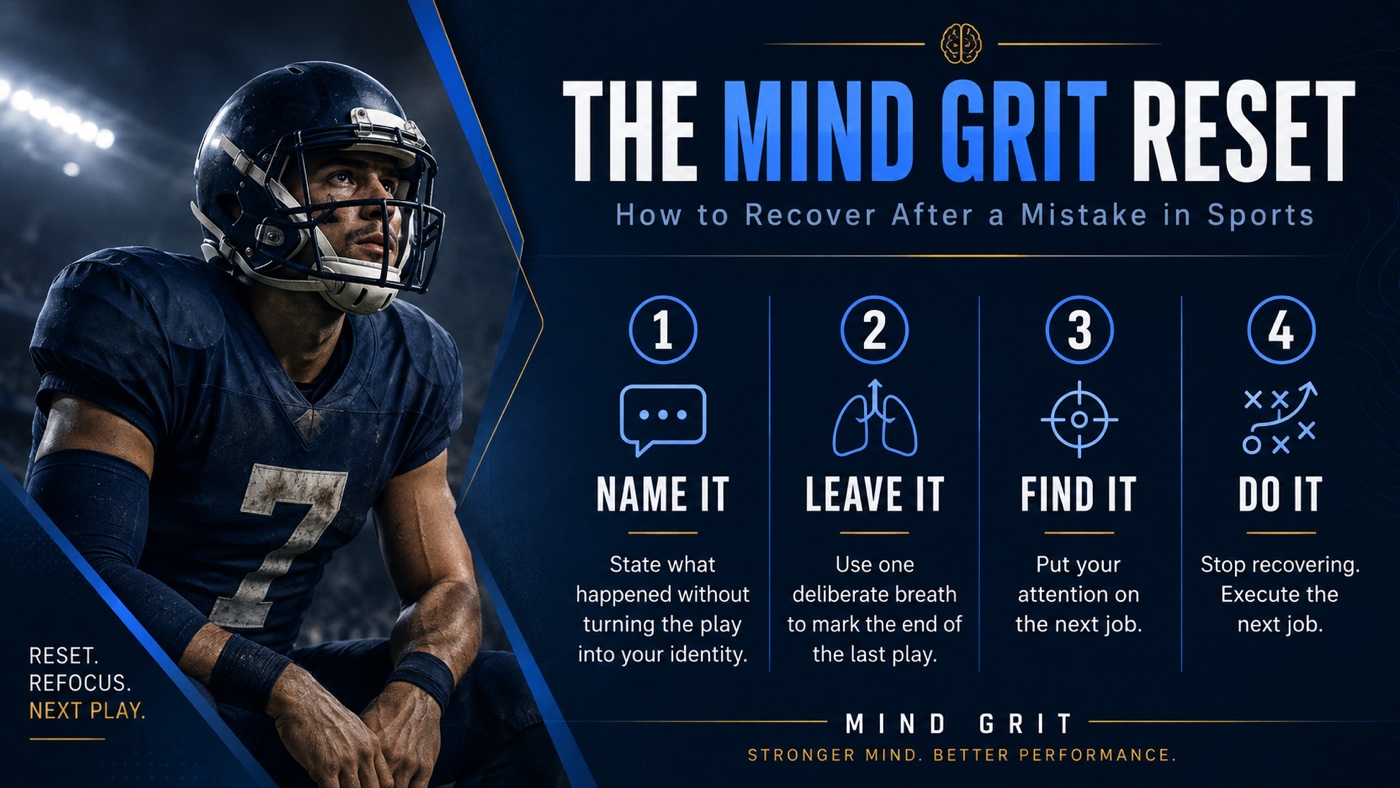
- NAME IT State what happened without turning the play into your identity.
- LEAVE IT Use one deliberate breath to mark the end of the last play.
- FIND IT Put your attention on the next job.
- DO IT Stop recovering. Execute the next job.
The One-Play Response
Competition is not the time for a psychology lecture. Your response has to be simple enough to use while the game is moving.
- 1. NAME IT This happened.
- 2. LEAVE IT One breath. That play is over.
- 3. FIND IT What is my next job, next play etc.?
- 4. DO IT Go.
Simple on purpose. For younger athletes, the sideline cue can be even shorter: Name it. Breathe. Next job. Go.
Why One Mistake Can Become Three
I have watched this happen over and over as a coach. A quarterback throws an interception. A receiver drops a ball he catches almost every time. A basketball player misses an open shot. A shortstop boots a routine ground ball.
The play ends, but the athlete stays inside the last play-the mistake. You can see it in their eyes, their shoulders, and their glance toward the sidelines. Their body is standing in the huddle, but their attention is still somewhere behind it.
Now the next play is coming. The game keeps moving.
You Replay the Mistake
How did I miss that? Coach is going to pull me. Everybody saw it. I always do this.
There is nothing unusual about having thoughts after a mistake. The problem begins when those thoughts compete with the information you need for the next play. Instead of reading the defense, tracking the ball, or finding your assignment, you are watching your own mental replay.
You Try to Pay Back the Last Play
A mistake can create a false debt: I have to make up for it right now. That is when athletes force a throw, rush a shot, swing at a bad pitch, or abandon their assignment to make a heroic play.
The scoreboard does not let you trade the next play for the last one. The last one is gone. Trying to repay it often turns one mistake into another.
You Start Performing for the People Watching
Young athletes often stop asking, What does this play require? and start asking, What does everyone think about me? They look toward the coach, the bench, or the stands. Their attention moves from the task to the judgment they imagine is coming.
That is a hard place to perform from.
The Mistake Is Not the Emergency
A missed shot or dropped pass is obviously not a medical emergency. But years of working in high-pressure environments have taught me something useful about performance: panic makes the next decision harder.
In emergency medicine, you cannot go backward and change the previous five minutes. You assess what is happening now. You identify the next priority. You act. Then you reassess.
Sports require a much lower-stakes version of the same skill. The interception happened. The strikeout happened. The bad call happened. The useful question is no longer, How do I make that unhappen?
You cannot. The useful question is: What does the next moment require from me?
The Four Steps of the One-Play Response
1. Name It
Start with reality: That happened. You dropped it. You missed it. You got beat. You made the wrong read.
That is different from saying, I am terrible, or, I always choke. Those statements take an event and turn it into an identity.
I made a bad play describes an event. I am a bad player makes the event who you are. Keep them separate. Name what happened without becoming what happened.
2. Leave It
The play is over. Take one deliberate breath and leave it where it happened. Not because one exhale erases frustration or anxiety. It does not. The breath gives you a physical action that marks a boundary:
Leaving it does not mean ignoring the mistake. It means resetting now and learning later. During competition, perform. Afterward, review.
3. Find It
Move your attention away from the replay in your head and toward information that matters now.
Ask: What is my job? Then put your eyes on something outside yourself: the formation, the pitcher's release, the rim, your opponent's hips, the next serve, your defensive assignment, or the coach's call.
Give yourself a short cue if you need one: Next play. Do my job. Next pitch. Eyes up. Commit. Then find the information your sport requires.
Your breath and cue are not the destination. They are the bridge. Finding the next job reconnects you to the game.
4. Do It
Go play. Make the call, take the shot, run the route, cover your assignment, or compete for the next ball.
This final step matters because mistake recovery cannot become another thinking exercise. Once you know the next job, act. Stop checking whether you feel better. Stop grading the response. Execute what the moment requires.
You Do Not Have to Feel Right Before You Act Right
Athletes often believe they have to get their confidence back before they can play well again. Not necessarily.
You can still be disappointed and execute your assignment. You can still be nervous and take the shot. You can still be angry and cover your player. You can still be embarrassed and throw the next strike.
Feelings matter, but feelings are not always commands. Sometimes the next step is behavioral: get your eyes back where they belong, get your body where it belongs, and do your job. Let your emotions catch up.
That is not suppressing emotion. It is refusing to require the perfect emotional state before you compete again.
Confidence is built long before the next pressure moment arrives. For a deeper training plan, read How to Build Confidence in Sports.
Respond Now. Learn Later.
The One-Play Rule does not mean ignoring mistakes, refusing coaching, or pretending nothing went wrong. Athletes need to study film, correct technique, and learn from failure.
But, there is a time for analysis and a time for performance. During competition, use the information that helps you execute the next job. Save the deeper review for the dugout, halftime, film, practice, or a conversation with your coach.
Practice Your Response Before You Need It
Athletes practice shooting, throwing, hitting, footwork, routes, strength, and speed. Then they expect themselves to know how to respond emotionally when something goes wrong in a game.
Train that too.
Use the One-Play Response after mistakes in practice. Drop the pass? Name it, leave it, find the next job, and do it. Miss the shot? Same process. Lose the rep? Same process. Do not wait for game day. Build the response during the week.
A Three-Practice One-Play Challenge
- Notice your normal reaction after a mistake. Do you look at the coach, drop your head, get angry, rush, blame, or try to make a huge play?
- Choose one cue that fits your sport and position.
- Use the complete One-Play Response after every meaningful mistake in your next three practices.
- Do not judge the response by whether you immediately felt better. Ask whether your attention returned to the next job.
What the Research Says
There is no peer-reviewed study proving that every athlete should use one universal mistake-recovery routine. Every athlete, sport, and competitive situation is different. A golfer has more time between attempts than a linebacker has between snaps.
Research does, however, support several ideas built into this approach:
- A 2011 meta-analysis found a moderate positive overall effect of self-talk interventions on sport-related performance. Interventions that included deliberate self-talk training were more effective than those that did not.[1]
- A systematic review found benefits from several forms of purposeful self-talk, while also challenging the simplistic claim that every negative thought automatically harms performance.[2]
- Research using reports from expert athletes found that attention under pressure often shifted toward performance worries. That supports the practical need to redirect attention toward task-relevant information.[3]
- A 2026 meta-analysis found that several psychological interventions improved sport-specific performance under pressure, with stronger and more consistent findings in closed-skill tasks than in open-skill environments.[4]
The One-Play Rule and its four-step response are Mind Grit coaching frameworks, not independently validated clinical or psychological protocols. Their purpose is to combine useful performance principles into a short routine an athlete can practice and apply.
Fall 7• Rise 8
A lot of young athletes misunderstand mental toughness. They think mentally tough athletes never get nervous, lose confidence, become angry, or make mistakes.
That athlete does not exist.
Fall 7• Rise 8 does not mean never fall. It asks: How will I respond when I do? The rise is where the magic happens and the growth occurs. Mistakes and setbacks are guaranteed if you compete long enough. The skill is in how you respond. You no longer control the play that ended five seconds ago, you control the rise, ie, the response.
Scripture does not promise that the faithful never fall. They rise again. Falling is part of the story. So is getting back up.
One Mistake Is Not Your Identity
Sports feel personal because you care. You trained all offseason. Your family came to watch. Your teammates depend on you. You want the starting spot, the scholarship, or the chance to prove yourself.
That is why a mistake can feel like it says something about who you are. It does not.
A turnover is data. A missed shot is an event. A strikeout is an outcome. Learn from it. Care about it. But do not let it define your worth.
You can say, That was not good enough, without saying, I am not good enough. That distinction gives you room to improve without tearing yourself apart every time you fall short.
Frequently Asked Questions
How do athletes recover quickly after making a mistake?
Use a short, practiced routine that moves you back into action. Mind Grit uses the One-Play Response: Name it, Leave it, Find it, Do it.
Why do I keep thinking about mistakes during games?
Mistakes feel important, so they capture attention. The goal is not to force the thought away. Give your attention a better target by asking, What is my next job? Then look for the information required to do it.
How do I stop getting angry after a mistake?
Do not make never feeling angry the requirement. The goal is keeping anger from controlling your next decision. You may still feel it and still execute your assignment.
What should I say to myself after a mistake?
Keep the cue short and connected to the task: Next play, Do my job, Next pitch, Eyes up, Commit, or Attack. The best cue is one you have practiced and that points your attention toward useful action.
Should I analyze my mistake during the game?
Use a quick technical correction when it is necessary. But do not replay the entire failure. Ask what information will help the next play, use it, and save the deeper analysis for film or practice.
The Next Play Still Belongs to You
You are going to make another mistake. So will your coach. So will the best athlete you have ever watched.
The goal is not to create an athlete who never falls. The goal is to build an athlete who knows what to do after the fall.
Name it. Leave it. Find the next job. Do it.
But you have to train for it just like you would train for a game, a marathon, or a meet. You have to work the muscle so that this becomes instinctual just like running or jumping. Making one mistake cost you only one play is a skill and the skill is improved upon with practice and training.
Pressure is coming.Train for it.
Start With the Five Pillars
If you or another athlete you know is struggling with resetting and putting mistakes behind you, start with the 5 Pillars guide that I created to give athletes a framework to start working through some of these issues.
The One-Play Rule is one practical expression of the Mind Grit System. Download the free Five Pillars Guide to learn the framework athletes can use to pursue excellence, build confidence, focus on what they control, respond to adversity, and compete freely.
Download the Free Five Pillars Guide
Related Mind Grit Articles
- How to Focus Under Pressure in Sports — Give your attention one external job when the moment gets big.
- How to Stop Being Afraid of Making Mistakes in Sports — Stop playing not to lose and give yourself permission to compete.
- How to Build Confidence in Sports — Build confidence from preparation and evidence before you need it.
About Graves Fromang, DO
Graves Fromang, DO, is a husband, father, board-certified emergency physician, mental performance and football coach, former college football player, and founder of Mind Grit. He created the Mind Grit System to give athletes a practical, faith-grounded framework for training confidence, attention, response, and identity when pressure arrives.
Learn more about Graves and Mind Grit
Evidence Note
The One-Play Rule and One-Play Response are Mind Grit applied coaching frameworks. Research supports individual concepts incorporated into the framework, including trained self-talk, attentional redirection, and structured psychological strategies for performance under pressure. The frameworks themselves have not been independently validated as clinical treatments, psychological protocols, or universal performance interventions.
References
1. Hatzigeorgiadis A, Zourbanos N, Galanis E, Theodorakis Y. Self-talk and sports performance: A meta-analysis. Perspectives on Psychological Science. 2011;6(4):348–356. doi:10.1177/1745691611413136
2. Tod D, Hardy J, Oliver E. Effects of self-talk: A systematic review. Journal of Sport & Exercise Psychology. 2011;33(5):666–687. doi:10.1123/jsep.33.5.666
3. Oudejans RRD, Kuijpers W, Kooijman CC, Bakker FC. Thoughts and attention of athletes under pressure: Skill-focus or performance worries? Anxiety, Stress & Coping. 2011;24(1):59–73. doi:10.1080/10615806.2010.481331
4. Zeng Z, Yan W, Mohammadi A, Toumi Z, Sun H, Soh KG. Counteracting choking under pressure in sport: A meta-analysis of interventions. Psychology of Sport and Exercise. 2026;85:103130. doi:10.1016/j.psychsport.2026.103130
Medical and Mental Health Disclaimer
Mind Grit provides educational mental-performance content for athletes, parents, and coaches. It is not medical advice and is not a substitute for individualized medical care, diagnosis, psychological treatment, or mental-health counseling. Participation in Mind Grit content or coaching does not create a physician-patient relationship.
Athletes experiencing persistent anxiety, depression, panic, disordered eating, self-harm thoughts, or other significant mental-health or physical health concerns should seek evaluation from an appropriately licensed healthcare or mental-health professional.